


The state department said the freeze would remain in place until Islamabad took action against the Haqqani network and the Afghan Taliban.
Earlier this week, President Trump accused Pakistan of lying and deceiving the US while receiving billions in aid.
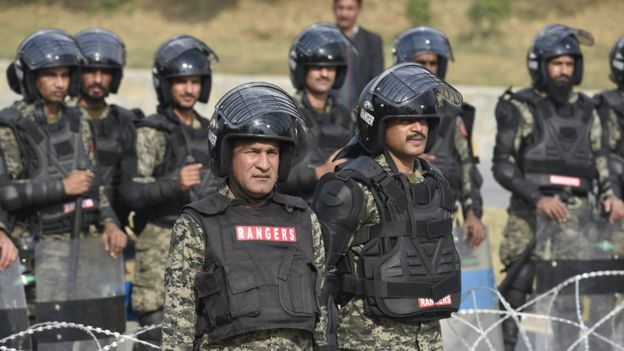
The Pakistan government has forcefully pushed back against the US, a key ally.
After the earlier comments by Mr Trump it called attacks on it by US officials "incomprehensible" and said they "negated the decades of sacrifices made by the Pakistani nation".
The US stance has been praised by India and Afghanistan, but China, which is investing tens of billions in Pakistan, has backed it.
- Trump targets Pakistan in first 2018 tweet
- US rhetoric on Pakistan raises serious questions
- Will Pakistan ever stamp out extremism?
The Trump administration had already delayed handing over $255m (£188m) in military aid to Pakistan.
In announcing the restrictions, state department spokeswoman Heather Nauert said she could not yet put a dollar value on how much aid was being cut.
She said the US government considered that the Afghan Taliban and the Haqqani network were "destabilising the region and also targeting US personnel".
On Thursday, the state department also placed Pakistan on a special watch list for "severe violations of religious freedom".
Longstanding grievance
Barbara Plett Usher, BBC News State Department Correspondent
The US and others have long complained that Pakistan gives safe haven to the Afghan Taliban and their allies, the Haqqani network, allowing them to carry out cross-border attacks in Afghanistan. That's something Islamabad denies but President Trump has escalated the criticism since he took office.
Pakistan reluctantly joined Washington's War on Terror after the 9/11 attacks and has received billions of dollars in assistance as a result. That funding has been falling for some time because of US frustrations, but the uneasy relationship continued, as America needs the cooperation Pakistan does provide.
The Pakistanis say they've suffered great losses from the longstanding war against Islamist networks and are furious that Mr Trump fails to acknowledge the role they've played.
Who are the militants Pakistan is alleged to support?
The Haqqani network is a militant group that focuses most of its activities on neighbouring Afghanistan, which has complained for years that Pakistan allows it to operate unimpeded from its soil across the border.
The group is linked to the Afghan Taliban - a hardline Islamic movement that poses a major threat to the Afghan government. Pakistani Taliban groups, while associated with the Afghan Taliban, focus on attacks within Pakistan.
- Who are the Taliban?
- Life after militants lost the battle for North Waziristan
Both the Haqqani Network and the Afghan Taliban have launched attacks in Afghanistan that have killed US forces, and US officials have long argued that Pakistan, and specifically its ISI intelligence service, provides safe havens to them.
The New York Times has reported that US officials were last year denied access by Pakistani officials to a member of the Haqqani network who they believed could help with information on an American hostage.
Why would Pakistan support them?
Pakistan has long been accused of using the Afghan Taliban to further its foreign policy interests in the country. The ISI first became involved in funding and training militants in Afghanistan after the Soviet invasion in 1979.
Although since 2001 Pakistan has allowed its territory to be used to supply international troops during the war in Afghanistan, and co-operated with the West in fighting some terrorists groups like al-Qaeda, analysts say it has continued to give shelter and support to Afghan insurgents.
Its aim has been to limit the influence in Afghanistan of its chief regional rival, India.
[BBC SOURCES]
The North Korean soldier had walked across the Demilitarized Zone (DMZ) shortly after 08:00 (23:00 Wednesday).
He had emerged from thick fog at a checkpoint, said the South's military.
He is the fourth North Korean soldier to defect this year. The incident comes weeks after one of the most dramatic defections in recent times.
In that incident, on 13 November, a soldier was shot as he fled across to the southern side of the Joint Security Area (JSA) in the village of Panmunjom.
- N Korea defector has 'enormous parasites'
- North Korean defector: What we've learned from dramatic footage
- Nine charts which tell you all you need to know about North Korea
- How to dodge mines and snipers on the Korean border
On Thursday, South Korea's defence ministry said its soldiers had fired around 20 warning shots when border guards from the North approached the border, appearing to be searching for the North Korean soldier who had defected hours earlier.
The defection occurred along the border in Gangwon province, according to South Korea's national broadcaster KBS.
The soldier was taken into custody and Seoul is now investigating his intentions.
Very few North Korean defectors risk crossing to the South via the DMZ.
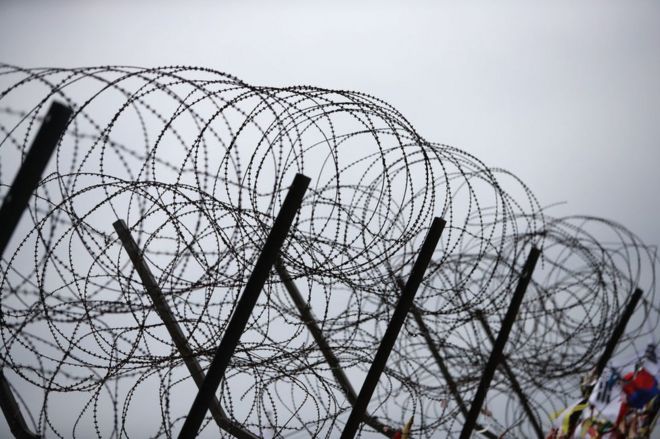
One of the world's most heavily guarded strips of land, the DMZ is a thin buffer zone between the two Koreas and is fortified on both sides with barbed wire, surveillance cameras, electric fencing and landmines.
Last month's defection saw a soldier drive a jeep right up to the border, in a dramatic escape captured on surveillance cameras.
He ran across to the South in a hail of bullets from North Korean guards.
Shot five times, the soldier collapsed in a pile of leaves on the South's side, and was later rescued by South Korean soldiers.
His recovery was closely tracked by South Korean media for every twist and turn of his medical condition. He was released from intensive care and is reported to have written a thank you note to the doctors who treated him.
In a separate announcement on Thursday, South Korea's unification ministry said two North Koreans found on a fishing boat in the South's waters had defected, reported Yonhap news agency.
[BBC SOURCES]
Earlier this month, Mr Trump took that step amid international criticism.
"They take hundreds of millions of dollars and even billions of dollars, and then they vote against us," he told reporters at the White House.
"Let them vote against us. We'll save a lot. We don't care."
His comments come ahead of a UN General Assembly vote on a resolution opposing any recognition of Jerusalem as Israel's capital.
- Anger in Ramallah and delight in West Jerusalem
- The view from one street
- Trump Jerusalem shift puts counter-terror efforts at risk
The draft resolution does not mention the US, but says any decisions on Jerusalem should be cancelled.
Earlier, US ambassador to the UN Nikki Haley warned member states that President Trump had asked her to report on "who voted against us" on Thursday.
Analysis
By Nada Tawfik, BBC News, New York
President Trump and Ambassador Haley are trying to use American muscle rather than diplomacy to convince countries to vote their way. From Washington's perspective, recognising Jerusalem as Israel's capital and deciding to move its embassy there is its sovereign right.
But that's not how the majority of countries at the United Nations see it.
The strongest repudiation came, unsurprisingly, from Washington's critics.
Meanwhile, many US allies are brushing off the tough rhetoric as an empty threat.
A senior diplomat told me it was clear that the Trump administration was determined to take a stand for Israel at the UN, but he doubted that Washington would cut aid to, say, Egypt - which sponsored the failed Security Council measure on which the General Assembly draft resolution is based.
What is certain is that the US will be isolated in the General Assembly on Thursday as the rest of the world once again tells President Trump that it does not agree with his decision on Jerusalem.
The status of Jerusalem goes to the heart of the Israeli-Palestinian conflict.
Israel occupied the east of the city, previously occupied by Jordan, in the 1967 Middle East war and regards the entire city as its indivisible capital.
The Palestinians claim East Jerusalem as the capital of a future state and its final status is meant to be discussed in the latter stages of peace talks.
Israeli sovereignty over Jerusalem has never been recognised internationally, and all countries currently maintain their embassies in Tel Aviv. However, President Trump has told the US state department to start work on moving the US embassy.
The 193-member UN General Assembly will hold a rare emergency special session on Thursday at the request of Arab and Muslim states, who condemned Mr Trump's decision to reverse decades of US policy earlier this month.
The Palestinians called for the meeting after the US vetoed a Security Council resolution, which affirmed that any decisions on the status of Jerusalem were "null and void and must be rescinded", and urged all states to "refrain from the establishment of diplomatic missions in the holy city".
The other 14 members of the Security Council voted in favour of the draft, but Ms Haley described it as an "insult".
The non-binding resolution put forward by Turkey and Yemen for the General Assembly vote mirrors the vetoed Security Council draft.
The Palestinian permanent observer at the UN, Riyad Mansour, said he hoped there would be "overwhelming support" for the resolution.
But on Tuesday, Ms Haley warned in a letter to dozens of member states that encouraged them to "know that the president and the US take this vote personally".
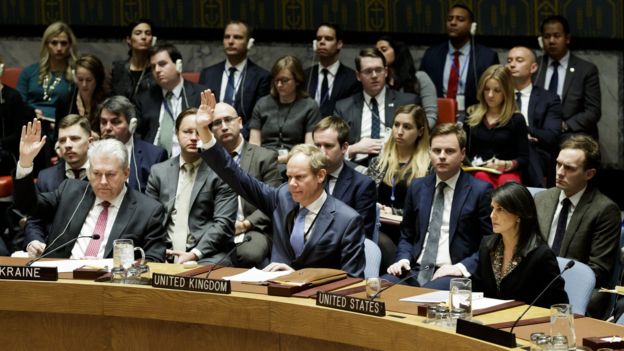
"The president will be watching this vote carefully and has requested I report back on those countries who voted against us. We will take note of each and every vote on this issue," she wrote, according to journalists who were shown the letter.
"The president's announcement does not affect final status negotiations in any way, including the specific boundaries of Israeli sovereignty in Jerusalem," she added. "The president also made sure to support the status quo of Jerusalem's holy sites."
Ms Haley echoed the warning on Twitter, writing: "The US will be taking names."
Palestinian Foreign Minister Riyad al-Maliki and his Turkish counterpart, Mevlut Cavusoglu, accused the US of intimidation.
"We see that the United States, which was left alone, is now resorting to threats. No honourable, dignified country would bow down to this pressure," Mr Cavusoglu told a joint news conference in Ankara on Wednesday before travelling to New York.
[BBC SOURCES]
"Let's just meet and let's talk about the weather if you want," he said at a policy forum in Washington DC.
His statement appeared to shift the US position away from previous demands that North Korea must first disarm.
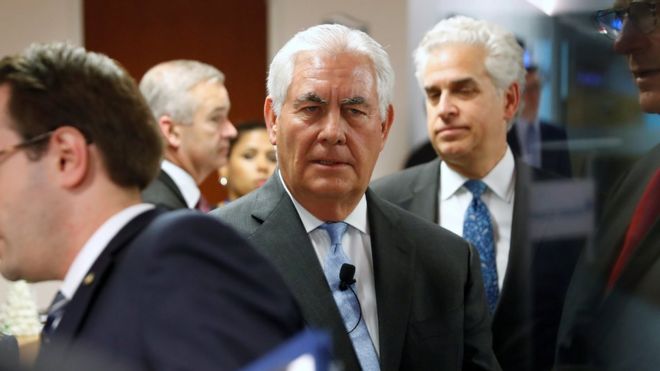
North Korea's pursuit of nuclear weapons technology has led to heavy US-led sanctions against the regime.
Elsewhere in his remarks, Mr Tillerson insisted that the economic and diplomatic sanctions would continue until "the first bomb drops".
- What did N Korea's nuclear tests achieve?
- What missiles does North Korea have?
- Why is the latest test still producing aftershocks?
Diplomatic relations between the two nations have been strained by recent North Korean missile tests, and by a war of words between US President Donald Trump and North Korea's leader Kim Jong-un.
Speaking at the Atlantic Council policy forum, Mr Tillerson said that the US "simply cannot accept a nuclear armed North Korea".
But appearing to soften the US stance to talks, he said: "Let's just meet and let's talk about the weather if you want and talk about whether it's going to be a square table or a round table if that's what you're excited about.
"Then we can begin to lay out a map, a road map, of what we might be willing to work towards."
Mr Tillerson also said that China had made contingency plans to accommodate North Korean refugees in the event of a conflict.
[BBC SOURCE]
President Donald Trump's populist brand will be tested after he backed ultra-conservative Roy Moore, who is accused of misconduct by multiple women.
Much of the Republican establishment has distanced itself from the 70-year-old former Alabama judge.
The race between Mr Moore and Democrat Doug Jones is too close to call.
The Republican candidate has said homosexual activity should be illegal and argued against removing segregationist language from the state constitution.
But it is sexual misconduct claims against him by a number of women, mostly when they were teenagers, that have made Washington conservatives baulk.
One accuser alleges Mr Moore molested her when she was 14. Another says he tried to rape her.
The scandal has put an Alabama Senate seat within reach of Democrats for the first time in more than two decades.
Repercussions beyond Alabama
Gary O'Donoghue, BBC News, Montgomery
Elections are rarely competitive in Alabama. It's the kind of place Republicans might as well weigh their votes rather than count them, such is the party's dominance here.
This special election has upended all the normal expectations and still, at this late stage, remains too close to call.
Democrat Doug Jones can win if he manages to galvanise the black vote in cities such as Birmingham and Montgomery.
Roy Moore, his Republican rival, could easily lose if those rural, white, church-going conservatives stay at home amid the allegations against him.
Whatever the outcome, the repercussions will be felt beyond Alabama.
If the Republicans lose, their Senate advantage contracts to just one vote.
If they win, their candidate is likely to face months of ethics inquiries, and an outside chance of being expelled from the Senate.
For the Democrats, a win would bolster their bargaining power in Congress, and place control of the Senate within definite grasp at next year's mid-term elections.
How does Moore respond?
On Tuesday, the world's press were waiting as he emerged on horseback from woodland to a ballot station.
He said people should "go out and vote their conscience".
Making his final pitch on election eve, Mr Moore reiterated his denials, again questioning why his accusers had kept quiet for 40 years while he had held various political offices.
Speaking alongside Mr Trump's former chief strategist, Steve Bannon, in front of a crowd that chanted the president's slogan "Drain the Swamp", Mr Moore drew heavily from the Bible.
"I want America great," he said, "but I want America good and she can't be good until we go back to God."
Mr Moore was joined at Monday's rally by his wife Kayla, who said separate allegations last week that her husband was anti-Semitic were "fake news".
"One of our attorneys is a Jew, we have very close friends who are Jewish," she said.
How has Washington reacted?
In an automated phone message on Monday, Mr Trump's voice warned voters that his agenda would be "stopped cold" if Mr Moore lost.
But many other leading Republicans, including Senate Majority Leader Mitch McConnell, have kept arm's length from their party's candidate, or shunned him altogether.
Without mentioning Mr Moore by name, Republican former Secretary of State Condoleezza Rice, an African-American who grew up in Alabama, urged her home state to "reject bigotry, sexism, and intolerance".
Richard Shelby, Alabama's other senator, said on Sunday the state "deserves better" than Mr Moore.
A Democratic lawmaker has sent a letter to the Senate urging steps to protect teenagers working in the chamber's page programme from Mr Moore's "predatory conduct".
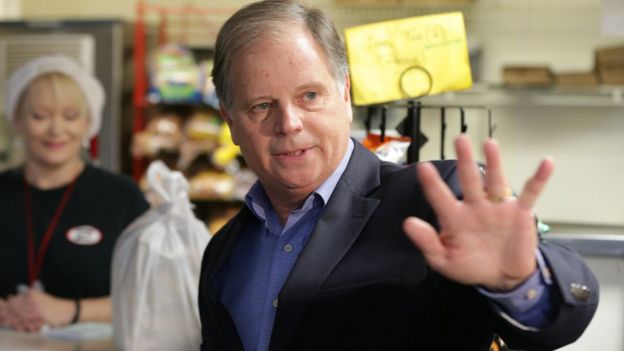
Mr Jones, a 63-year-old former prosecutor, denies opponents' claims he will be a "puppet" of the Democratic congressional leadership.
He is lauded for helping convict two Ku Klux Klan members who bombed a black church in 1963 in Birmingham, killing four girls.
But Mr Jones' support for abortion rights is toxic to many Christian conservatives in Alabama.
After casting his ballot on Tuesday morning, he predicted: "I don't think Roy Moore is going to win this election."
Former President Barack Obama has recorded an automated phone message for Mr Jones.
"This one's serious," Mr Obama told voters in his call. "You can't sit it out."
[BBC SOURCES]
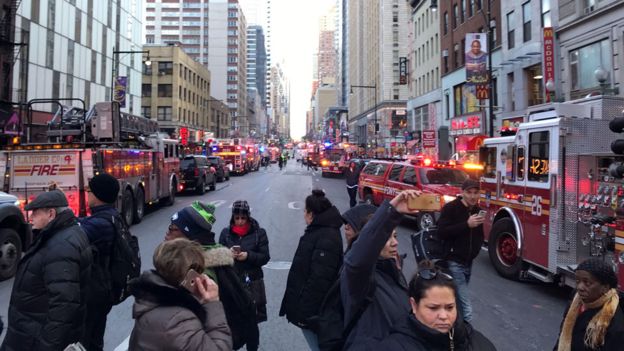
[BBC SOURCES]........"Terrorists won't win," Mayor Bill de Blasio said after a blast at the Port Authority terminal in Manhattan during the morning rush hour on Monday.
The suspect, Akayed Ullah, a 27-year-old Bangladeshi immigrant, was injured by a "low-tech explosive device" strapped to his body, officials say.
Three other people suffered minor wounds when it blew up in an underpass.
A photo circulating on social media shows a man, said to be Akayed Ullah, lying on the ground with his clothes ripped and lacerations on his upper body.
Mayor De Blasio said he was believed to have acted alone.
New York Governor Andrew Cuomo said: "This is New York. The reality is that we are a target by many who would like to make a statement against democracy, against freedom.
"We have the Statue of Liberty in our harbour and that makes us an international target."
The explosion occurred at about 07:30 (12:30 GMT). Andre Rodriguez, 62, told the New York Times: "I was going through the turnstile. It sounded like an explosion, and everybody started running."
Another eyewitness, Alicja Wlodkowski, told Reuters news agency that she had seen a group of about 60 people running. "A woman fell. And nobody even went to stop and help her because the panic was so scary," she said.
Nearby subway stations were evacuated, and the Port Authority Bus Terminal temporarily shut.
It is the biggest and busiest bus terminal in the world, serving more than 65 million people a year.
The suspect's home in the New York City borough of Brooklyn is being searched, the New York Times reports.
He may have been recently working at an electrical company, according to the New York Post.
Mr Ullah emigrated to the US on a family visa in 2011. The Bangladeshi government said he had no criminal record in the country, which he last visited in September.
White House spokeswoman Sarah Sanders claimed that if Mr Trump's proposed immigration crackdown had already been in place, "the attacker would have never been allowed to come into the country".
"This attack underscores the need for Congress to work with the president on immigration reforms that enhance our national security and public safety," she added during a daily news briefing on Monday.
Recent New York terrorist incidents
- October 2017: An Uzbek immigrant drove a truck into pedestrians, killing eight people. He is facing murder and terror charges. It was the deadliest attack in the city since 11 September 2001.
- March 2017: A white US Army veteran killed a black man with a sword in Manhattan, saying he harboured hatred towards African Americans. He was charged with murder as an act of terrorism
- September 2016: An Afghan-American man planted pressure cooker bombs in New York and New Jersey. He was shot by police but survived to face court.
- October 2014: A Muslim convert was shot dead by police after attacking two officers with a hatchet. Police said he had become radicalised and the case was "a terrorist act".
- May 2010: A car bomb was found in Times Square, the city's busiest tourist area, and defused by police. A Pakistan-born US citizen was arrested and sentenced to life in prison in 2010.
The organisation "has outrageously been one of the world's foremost centres of hostility towards Israel", she said.
Mrs Haley was addressing an emergency meeting of the Security Council called after President Donald Trump's decision to move the US embassy to Jerusalem.
The move has been widely condemned and sparked clashes in the West Bank.
Israel has carried out air strikes against targets in the Gaza Strip, injuring a number of people, after Palestinian militants fired rockets into Israeli territory.
Two Palestinian men died after Israeli troops fired on crowds in Gaza during clashes earlier on Friday.
Tensions remain high across the Middle East after Mr Trump announced the US would recognise Jerusalem as the capital of Israel, reversing decades of US neutrality on the matter.
Israel has always regarded Jerusalem as its capital, while the Palestinians claim East Jerusalem - occupied by Israel in the 1967 war - as the capital of a future Palestinian state.
- Frank Gardner: Counter-terror efforts at risk?
Mrs Haley said the decision "recognises the obvious; that Jerusalem is the capital of Israel".
She said the US continued to be "committed to achieving a lasting peace agreement", and accused the UN of bias.
"Israel will never be, and never should be, bullied into an agreement by the United Nations or by any collection of countries that have proven their disregard for Israel's security."
The Palestinian representative, Riyad Mansour, said Mr Trump's move meant the US could no longer be seen as a broker of peace.
"Complicity must be recognised," he said.
Israel's representative, Danny Danon, thanked the US for what he called "a milestone for Israel, for peace, and for the world".
Also on Friday:
- Chief Palestinian negotiator Saeb Erekat said Palestinians would not talk to the US until Mr Trump reversed his decision
- Both Palestinian President Mahmoud Abbas and the highest Sunni Muslim authority in the world, the imam of al-Azhar mosque in Egypt, said they would not meet US Vice President Mike Pence when he visited the Middle East later this month
- US Secretary of State Rex Tillerson said it could take two years before the US embassy was relocated from Tel Aviv
- The Israeli army said a rocket had hit the town of Sderot in southern Israel, but did not say whether anyone had been injured
- Israeli aircraft attacked Hamas military facilities in Gaza in retaliation, the Israeli army said, and the area's hospital said 14 people were wounded
Where has there been violence?
In the West Bank, Israeli forces clashed with Palestinians in the cities of Bethlehem, Ramallah, Hebron and Nablus, as well as smaller locations.
Israel had deployed extra battalions to the West Bank in anticipation of violence after Palestinian leaders called for protests after Friday prayers.
At least 217 Palestinians were wounded in confrontations in the West Bank and East Jerusalem, Palestinian medics said.

Elsewhere, demonstrations against Mr Trump's announcement have spread.
Thousands of pro-Palestinian protesters held noisy demonstrations in Jordan, Egypt, Iraq, Turkey, Tunisia and Iran.
Further afield, protesters rallied in Malaysia, Bangladesh, Pakistan, Afghanistan, Indian-administered Kashmir and Indonesia, the world's largest Muslim-majority country.
Why does Trump's announcement matter?
Jerusalem is of huge importance to both Israel and the Palestinians. It contains sites sacred to the three major monotheistic faiths - Judaism, Islam and Christianity.
Israel occupied the eastern sector - previously occupied by Jordan - in 1967, and annexed it in 1980, but the move has never been recognised internationally.
Some 330,000 Palestinians live in East Jerusalem, along with about 200,000 Israeli Jews in a dozen settlements there. The settlements are considered illegal under international law, though Israel does not regard them as settlements but legitimate neighbourhoods.
- What are the alternatives to a two-state solution?
- Why settlement issue is so difficult
According to the 1993 Israel-Palestinian peace accords, the final status of Jerusalem is meant to be discussed in the latter stages of peace talks.
The last round of talks between Israel and the Palestinians broke down in 2014 and while the US is formulating fresh proposals, Palestinian officials have said Mr Trump's announcement has disqualified the US from brokering future negotiations.
[BBC SOURCES]


